Tag Archives: Featured

Sherwood Foresters on the Somme 1916

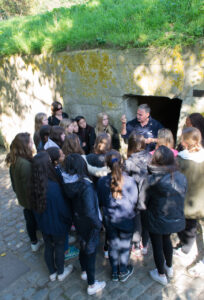
A few weeks ago I was asked to guide a group of family and friends from Nottingham to the Somme Battlefield. One of their ancestors was killed on 1st July 1916, the First Day of the Somme. He was a member of the 1/7th battalion, territorials and fell in the doomed diversionary attack on Gommecourt north of the main attack.
We could visit the site of the battle and find his name on the Thiepval Memorial to the Missing. The group had visited the Somme before. So I thought about an itinerary that would visit other places where the Sherwood Foresters (Notts and Derby Regiment) fought on the Somme.

Here is a summary of the Battalions of the Sherwood Foresters who fought on the Somme in 1916

Battalions Recruitment Formation Comments
1st Regular 24th Brigade, 8th Division In India in 1914
2nd Regular 71st Brigade, 6th Division In Sheffield in 1914
3rd  4th 13th & 14th Reserve and training In UK
1/5th Territorial Force (TF) 139th Brigade, 46th (North Midland) Division Drill Hall, Derby
1/6th TF 139th Brigade, 46th (North Midland) Division Chesterfield
1/7th (Robin Hood) TF 139th Brigade, 46th (North Midland) Division Nottingham
1/8th TF 139th Brigade, 46th (North Midland) Division Newark
9th (Service) K1 (Aug 14) 33rd Brigade, 11th (Northern) Division Formed Derby
10th (Service) K2 (Sap 14) 51st Brigade; 17th (Northern) Division Formed Derby
11th (Service) K3 (Sep 14) 70th Brigade in 8th then 23rd Division Formed Derby
12th (Service) Battalion (Pioneers K3 (Sep 14 24th Division Formed Derby
15th (Service) Battalion (Nottingham) Feb 15 by mayor and committee 105th Brigade in 35th Division Formed Nottingham as “bantams” below 5ft 2ins
16th (Service) Battalion (Chatsworth Rifles) Jun 15 by Duke of Devonshire  & Derbyshire TF Association 117th Brigade in 39th Division Formed Derrby
17th (Service) Battalion (Welbeck Rangers) Jun 15 by mayor and the committee 117th Brigade in 39th Division Formed Nottingham

The 3rd, 4th, 7th,8th, 13th and 14th battalions were reserve or depot units while the 20th was a Labour battalion.

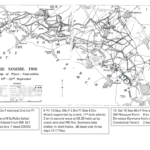
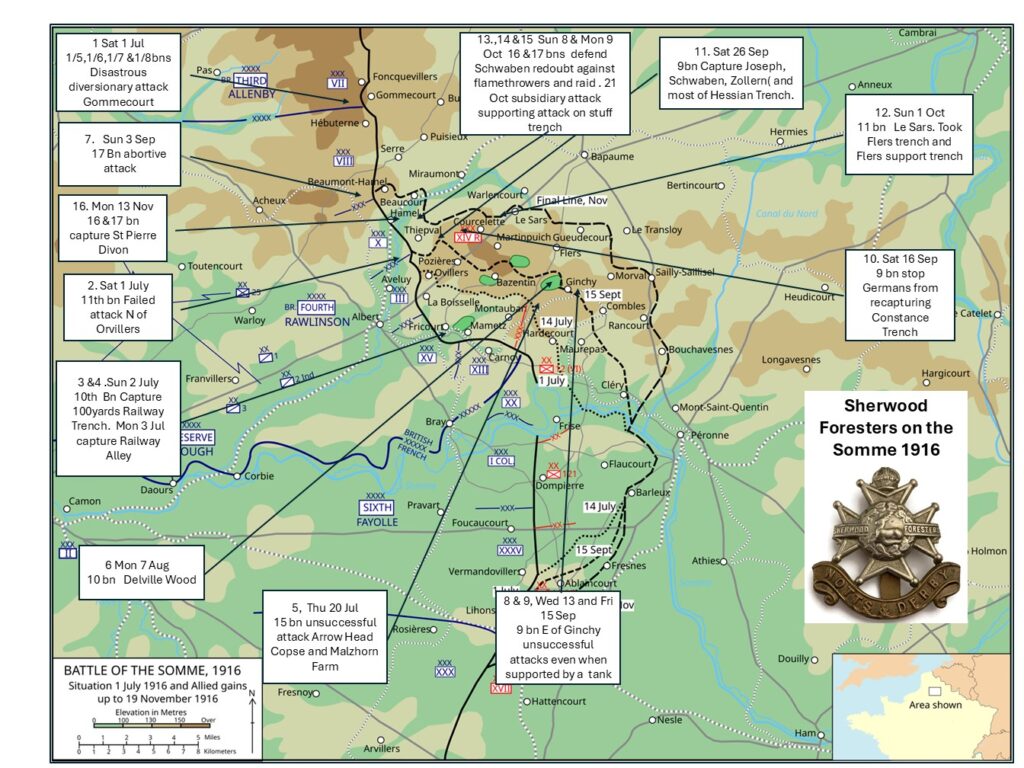
Chris McCarthy’s  Somme Day by Day lists sixteen actions where battalions of the Sherwood Foresters   are mentioned in the text.  Some of these are part of the Big Battle Days of the Somme, such as the first day, Flers Courcelette on 15th September,  Thiepval Ridge 26 September and the battle of the Ancre 13 Novembe. Others seem to have been more local operations.

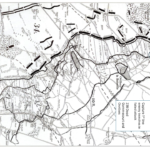
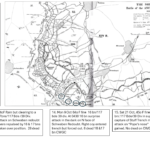
The map shows the location of these actions.
Date/weather  Location Unit Summary Result Casualties
1. Sat 1 July

72o F clear sky

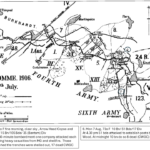
Gommecourt 1/5,1/6,1/7 &1/8 Bns Disastrous diversionary attack Failure 236 dead for both actions
2. 1 July Orvillers 11th Bn Failed attack N of Orvillers Failure
3. Sun 2 July

75o F clear sky

Fricourt 10th  Bn Capture 100yards Railway Trench Success No dead 2 July CWGC
4. Mon 3 July

68o F fine with some cloud and thunderstorms

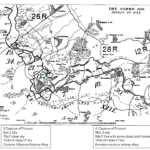
Fricourt- Capture of Railway Alley 10 Bn “Bombers” of 10 bn involved Success 7 dead 4-5 July CWGC
5. Thu 20 Jul

75o F fine morning, clear sky

Arrow Head Copse and Malzhorn Farm 15 Bn At 5 am after a 30-minute bombardment one company attacked each location , suffering heavy casualties from MG and shellfire.  Those parties that reached the trenches were shelled out Failure 17 dead CWGC
6. Mon 7 Aug

73o F

Delville Wood 10 bn At 4.30 pm 51 bde attacked to establish posts beyond Delville Wood. At midnight 10 bn do so Success 8 dead CWGC
7. Sun 3 Sep

72o F 4mm rain

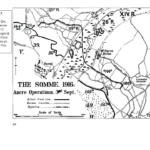
 Ancre Operations Mary Redan 17 Bn At 05.10 under intense barrage 116 and 117 bdes attacked on right & left, 116 captured front line trenches. 17 bn on left held up by MG fire. Failure 61 dead CWGC
8. Wed 13 Sep

72o F overcast

Quadrilateral E of Ginchy 2 bn At 6 pm 2nd Bn and 9 Suffolks failed attack on Quadrilateral from SW. 521 casualties for two bns Failure 7 dead CWGC
9. Fri 15 Sep

59o F

Quadrilateral E of Ginchy 2 Bn Attack supported by a tank. 2 bn in second wave at 08.20 held up by uncut wire and MG fire. Survivors take shelter in shell holes. Failure 38 dead over three days 15-17 Sep CWGC
10. Sat 16 Sep

66o F fine and sunny

SW Mouquet Farm 9 bn 9 bn stop Germans from recapturing Constance Trench Success 2 dead CWGC
11. Tue 26 Sep

75o F fine day

Between Thiepval and Mouquet Farm 9 bn As part of 33 Bde, capture Joseph,(12.45) Schwaben, Zollern(13.30) and all but 250m of the R side of Hessian Trench. (16.00) Success 36 dead CWGC
12. Sun 1 Oct

65o F sunny day

Transloy Ridge  SE Le Sars 11 bn Formed up in no man’s land and took Flers trench and Flers support trench Success 9 dead GWGC
13. Sun 8 Oct

64o F rain but clearing to a fine day

Schwaben Redoubt 16 & 17bns German night attack on Schwaben redoubt with flamethrowers repulsed by 16 & 17 bns who have just taken over position. Success 28 dead CWGC
14. Mon 9 Oct

64o F fine

Schwaben Redoubt 16 bn At 0430 16 bn surprise attack in the dark on N face of  Schwaben Redoubt. Right coy entered trench but forced out. Failure 6 dead 16 &17 bn CWGC
15. Sat 21 Oct

45o F fine but very cold

“Pope’s nose” 17 bn Subsidiary attack on “Pope’s nose “gained some ground” in support of attack on Stuff Trench Success No dead on CWGC
16. Mon 13 Nov

54o F

Ancre Valley 16 & 17 bns At 0615 16 bn attacked with two coys to clear dugouts in river banks and one coy along the top of the river bank. Germans taken by surprise. St Pierre Divon taken by mix of 16 bn, and other units. 16 bn rescue a bogged in tank under attack by Germans.  721 soldiers &13 Officers PW Success One dead  CWGC

CO reports

One officer KIA

4 ORs KIA

15 Missing

49 Wounded

The map shows the location of these actions.
The CWGC database lists 1000 men of the Sherwood Foresters who died between 1st June and 1st December 1916.  (The web page says there are over 2000 results, but the download lists 1000 names)

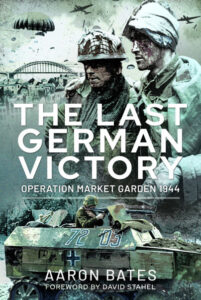
The Last German Victory: Operation Market Garden 1944

This looks like Aaron Bates’ masters thesis: the second chapter includes the word  “Historiography” in the title. He takes a different approach to Op Market Garden, looking at the doctrinal differences between the German and British forces and how this shaped the outcome of the battle. It excludes reference to American doctrine, It is an academic study rather than a direct historical narrative, so don’t read this if you don’t know anything about the battle. The foreword is by Australian academic David Stahl.

I have not seen this approach before. In a nut shell, the conditions of Op Market Garden played to German doctrinal strengths. The stress on individual initiative and aggression meant that the Germans recovered from surprise quickly. German emphasis on self contained infantry with high organic firepower gave them a tactical advantage. The airborne assault and supposed rapid follow up by ground forces denied the British the opportunity to employ the indirect firepower and careful; planning that gave success from El Alamein onwards. He argues that the operation should be seen as a German success rather than an Allied failure. The Germans pitted old men and recruits against the finest soldiers the Allies could muster. He has a good word for the otherwise disastrous attack by KG Grabner in depleting the limited ammunition of 2 Para at the bridge

He pulls no punches in copy that would raise the blood pressure of literate Paras in his description of the failures of 1st Airborne Division’s commanders and the rout of their soldiers.

There are flaws. His analysis of British doctrine is a little superficial. His bibliography does not include anything by Terry Copp or Marc Milner., or much by John Buckley. Nor does it include anyone who has written about artillery doctrine in WW2. No Bailey, Bidwell, Farndale, Pemberton or even Townend and Baldwin. There are some dubious statements about artillery. He ignores the decentralisation of British artillery between 1940 and 1942. Command of British artillery might be centralised at the highest level, but control was decentralised via the network of FOOs and BCs. The weapon of artillery is ammunition not the gun. The weakness of 1st Airborne’s artillery compared to an infantry division was not just fewer guns, but the absence of ammunition resupply by the RASC.

This may appear to be nit picking. However, given the importance firepower played in contemporary British doctrine, it would be reasonable to assume it had been  studied.

He looks in some detail at the development of German infantry doctrine in the 1920s from the first world war Stormtroops, but seems to treat British infantry doctrine of 1944 as if nothing had changed since 1918. This ignores the British debate in the 1920s from the Great War triggered by Liddell-Hart’s influential “Man in the Dark” paper. The expanding torrent tactic was leading the British in the same direction as the Germans even if ultimately rejected.   The author of the re written Infantry Training Vol 2 expunging Liddell-Hart’s ideas was Major B L Montgomery.

The lack of research on Montgomery is disappointing, given his role in the operation and a little unfair as the target of criticism.  Bates comments on Montgomery are largely clichés.  Hamilton’s detailed biography of Montgomery is not listed as a source. This might explain why he does not appear to be aware of Montgomery’s employment of airborne troops in Sicily in a smaller scale but equally risky venture.

It is stimulating reading even if you disagree with what he writes.

The maps are reprints from Robert Kershaw’s It never Snows in September and the Holt’s guide to the battle.
208 pages 20 b/w plates.

Listening Post No 10: Christopher Newbould: Presiding over a decade of the Realities of War

Colonel Christopher Newbould CB, who died in 2021, was an influential battlefield guide.

He was a founder member of the Guild of Battlefield Guides and a key member of the Validation team. He  was the lead guide for the Royal British Legion’s battlefield tour programme and, later, Spirit of Remembrance.   During his time with the Royal British Legion he was the pioneer guide for a Realities of War programme for soldiers under training, He then recruited , trained and managed the Legion guides for what was probably the largest single single  battlefield tour programme in the UK.  He recruited dozens of guides into the trade.

Christopher was a retired officer of the Gloucestershire Regiment, There is more about him on obituaries by

The RBGW Association

The Times

Click here to download the Podcast

You can hear Chris Scott talking about his friend Christopher Newbould here

Listening Post No 9: Alain Chissel: An Entrepreneurial Schools Guide

Alain Chissel served as a Regular and Territorial Officer for thirty years, retiring as Deputy Commander 49 (Eastern) Brigade in Chilwell, in the rank of Colonel.

Alain set up Anglia Tours, along with Ed Church and his wife Anita in 1997, which became the UK’s leading guided history tour company for schools.


He recently retired as it’s Chairman but remains as Head Guide. Alain is a passionate WW1 guide as both his grandfathers fought there. He also guides in Berlin and his Swedish wife Anita is the UKs most prolific Holocaust guide having led over 200 groups to Auschwitz/Birkenau.

Click here to download the Podcast

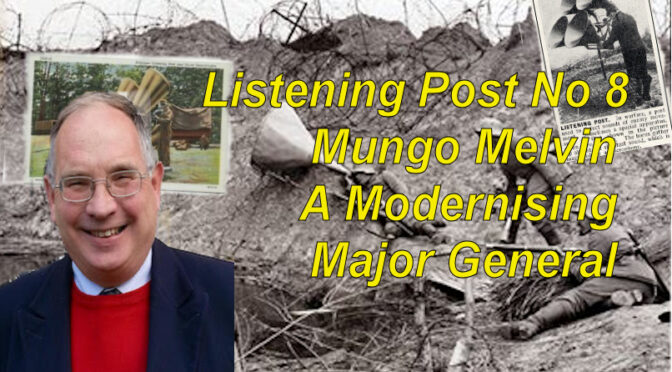
Listening Post No 8: Mungo Melvin – A modernizing Major General

Major General Mungo Melvin CB OBE was born in Edinburgh in 1955 and commissioned into the Royal Engineers in 1975. His military career took him into the development of military concepts and doctrine and in professional military education, teaching at Army Staff College, the Joint Services Command and Staff College and at the Royal College of Defence Studies.

He reintroduced some German General staff logic to the use of military history and battlefields by the British Army.  Mungo was instrumental in changing the Army’s approach to using historic battlefields as editor of an influential booklet on the relevance of military history to 21st century soldiers.  He organised some of the most high profile battlefield studies over the past decades, including the series of major staff rides to the Western Front of the First World War in 2014, 2016 and 2018.

He was President of the British Commission for Military History between 2012 and 2017 and edited the two volume British Army Battlefield Guide to the battlefields of the first world war.

Click here to download the Podcast

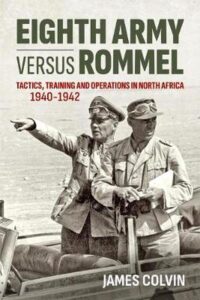
Book Review: James Colvin: Eighth Army versus Rommel, Tactics, Training and Operations in North Africa 1940-1942

James Colvin: Eighth Army versus Rommel, Tactics, Training and Operations in North Africa 1940-1942  Helion & Co Ltd 2020

This is James Colvin’s first book and is based on research undertaken for his MA.  It is an academic work in that it is sourced and draws on primary sources.  His academic tutor was Matthais Strohn, and this work displays rigour and insights informed by someone close to the British Army.

The book does what is says on the tin, and covers tactics training and operations.

However, its real strength is the clinical examination of the culture of the British and Indian Army  and how this hampered the commanders and staff of the Eighth Army in  developing effective tactics.

The author pieces together the thinking that led to the ineffective tactics and the influence of the Indian army approach to armoured warfare.  It is worth reading alone for the exposition of the thinking of Tom Corbett, Eric Dorman Smith and Francis Tuker and how this led to a battlefield of boxes.  Much of this is new analysis and adds a new dimension to any thinking about the desert war battles.

The author is related to two Gunner veterans of the campaign. One relative is the ill fated Beresford Peirse  quotes extensively from the papers of his relative Robin Dunn,, an HAC officer during the campaign.  However, the Gunners themselves  escape critical review without mention of  one question often asked.   Why didn’t the British Heavy Anti Aircraft guns in a similar way to the Germans 88?

The 261 page work is illustrated with relevant sketches and photographs.

It should be on the reading list of anyone interested in the war in North Africa 1940-1942 or in the wider British Army of that period.

Not particularly cheap, but affordable.  £29,95  RRP

Listening Post No 7: Chris Finn – Airman, Academic and Director of Validation

Group  Captain  Christopher Finn MPhil FRAeS FHEA served in the RAF for 33 years as a navigator, primarily on the Buccaneer, and was a weapons and tactics specialist. He has twice been awarded a Queen’s Commendation for Valuable Service in the Air. A graduate of the Joint Services’ Defence College, in 2000 he gained an MPhil in International Relations from Cambridge University. His last 5 years in the RAF were spent at Shrivenham, firstly on the Directing Staff of the Advanced Command and Staff Course and then, on promotion to Group Captain, as the RAF’s Director of Defence Studies. In this role he lectured extensively on air power to UK and international audiences, published articles on air power and ran the RAF’s staff ride programme.

On leaving the RAF in 2005 he spent ten years as a Senior Lecturer in Air Power Studies with Kings College London, later Portsmouth University, based at the RAF College Cranwell.

Chris’ primary expertise is in the influence of air power on the battlefield and areas such as joint fires, logistics, command and control, intelligence, campaign planning, leadership at all levels and the political aspects of warfare. However, he has also covered maritime battles (Malta & NEPTUNE) and land battles (Monte Cassino & Berlin).

Chris lectures on Aviation and Military History to a wide range of audiences including, recently, an on-line lecture on the role of the Royal Artillery in the Imjin River Battle of the Korean War. He is currently writing a chapter on Bomber Command tactics for a book on the Combined Bomber Offensive to be published in 2022.

He is a Fellow of both the Royal Aeronautical Society and the Higher Education Academy, and works as a volunteer Guide at the Battle of Britain Memorial Flight.

A member of the Guild since 2008 Chris gained his Badge in 2009, becoming a validator the following year. He has organised a number of Guild Events, the last being a Guild Recce to Berlin in 2019. He became the Chief Validator in 2015 and the Director of Validation (now Accreditation Director) in 2017. He was elected the fourth Fellow of the Guild at the 2020 Annual Conference.

Chris’ family home is in Caythorpe, Lincolnshire, where he lives with his wife and two retired Greyhounds. His other interests are flight simulators, swimming, yoga and cooking.

Click here to download the Podcast

Listening Post No 6: Julian Humphrys – Interpreting England’s Heritage

After reading History at Emmanuel College, Cambridge and completing a postgraduate course at the Polytechnic of North London, Julian spent 12 years at Chelsea’s National Army Museum, setting up special exhibitions including its acclaimed Road to Waterloo Gallery, liaising with the British Army and acting as spokesman to the media on all matters of military history. He has acted as a historical expert on many TV and radio programmes,  and made three expeditions to Bosnia during the Civil War to record the British Army’s activities there and to obtain objects for display in the Museum.

A qualified blue-badge guide, Julian set up English Heritage’s Tours Through Time programme of guided visits to historic properties and its battlefield hikes programme which he now leads. he also guides on a wide range of tours for special interest travel companies, both in the UK and overseas.

From 2009-2020 he was Development Officer of the Battlefields Trust, the UK Charity dedicated to the preservation and interpretation of Britain’s historic battlefields and is now a Trustee. Julian lectures and writes on many aspects of British history – he is a contributor to BBC History Magazine and History Revealed Magazine and his published books include   Clash of Arms: Twelve English Battles, and Enemies at the Gate: English Castles under Siege (both for English Heritage).

Click here to download the Podcast

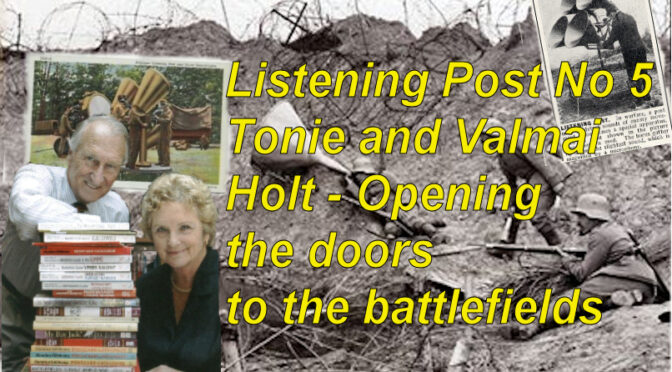
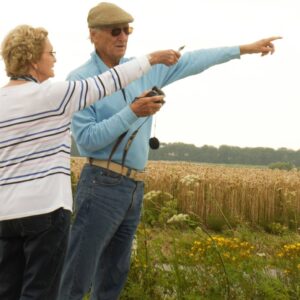
Listening Post No 5 Tonie and Valmai Holt – the couple who opened the doors to the battlefields

Tonie and Valmai set up the first modern commercial battlefield touring company in  the 1970s, when there was little tourist infrastructure or any previous model to follow.  They blazed the trail for guiding battlefields and sold their business in the 1990s to concentrate on their books.  They have been part of the virtuous circle that encouraged  the development of commemoration and tourist facilities in local communities on historic battlefields.  

Tonie and Valmai Holt started guiding when visitors included many veterans of the two world wars.  For some years they were responsible for organising and conducting Pilgrimages for the Royal British Legion.  They are honorary members of the Guild of Battlefield Guides International 

The podcast is divided into three parts.

Part One –  covers Tonie and Valmai’s background, how they came to set up Major and Mrs Holts Battlefield Tours, the challenges they faced setting up a battlefield touring company and some of the difficult problems they had to solve.

Part Two – The Holts tell some about some of the veterans they met, and share their stories,  some of their most emotionally moving experiences on historic battlefields and introduce a song about D Day that they would like to be passed on as widely as possible.

Part Three –  Tonie and Valmai talk about some of their most amusing experiences,  guiding in the last century and their advice for battlefield guides.

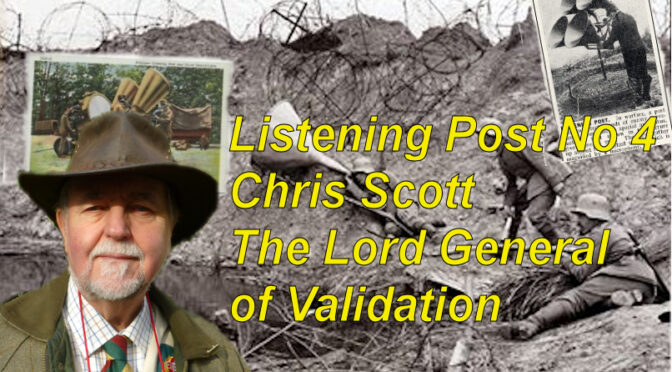
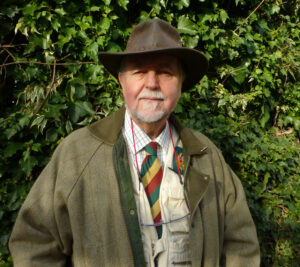
Listening Post No 4 Chris Scott – the Lord General of Validation

Dr. Christopher Scott has been walking battlefields for over 45 years and has been to 332 fields in 20 countries over 5 continents. He has guided sites of Medieval, Civil War, Marlburian and Napoleonic battles and was a Trustee of the Battlefield Trust and The Guild of Battlefield Guides, which he also helped create and designed their first Validation Programme. He formulated his own approach to battlefield study and has written several military history and battle books including a new and detailed interpretation of Roundway Down. Whilst in Education he led departments and faculty teams,  He and helped found a Further Education College. At The Royal Armouries he designed the education and public interaction programmes for the Leeds Museum. Chris is a freelance guide, lecturer, consultant and writer; he is also a good storyteller and a past winner of the Cameron Mackintosh Contemporary Playwright Award. He was the Lord General of the Roundhead Association.

Listen to the podcast